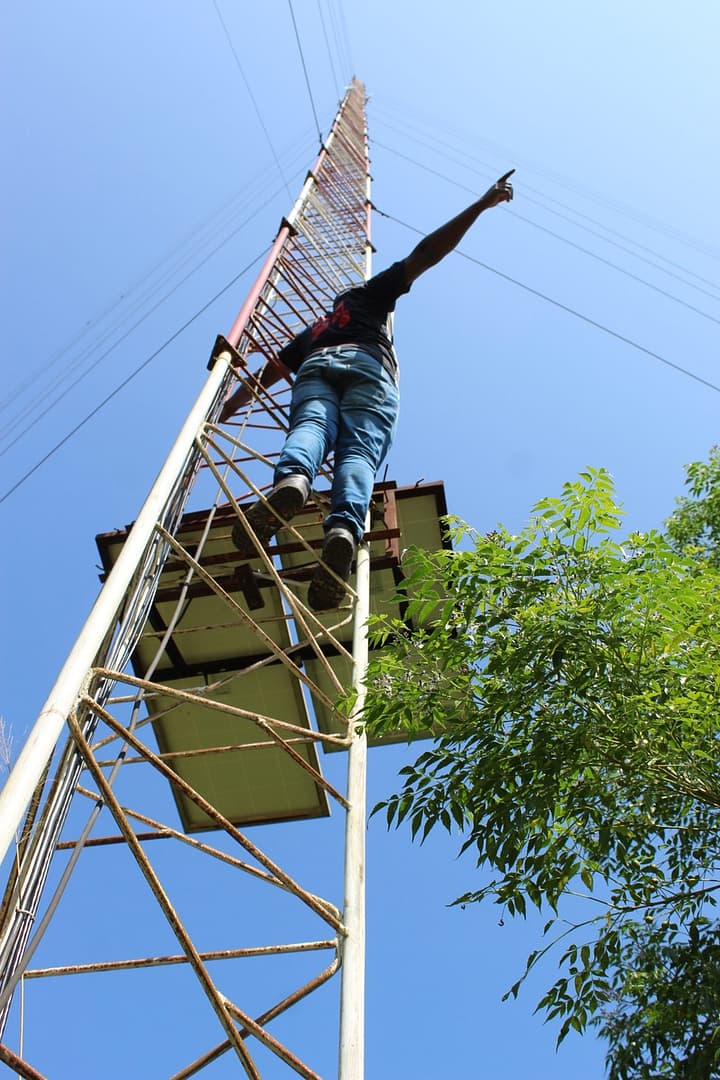
It’s been nearly 5 years now that BOSCO has been in Gulu, Uganda working with local rural communities to deliver solar powered ICT solutions and Internet capability to the villages. Inveneo was instrumental in our first deployment of our computing stations in 2007. And it was great to stumble across their Flickr feed and see a BOSCO “shout out” photo of one of the original ICT cites. Inveneo’s photo of one of the original BOSCO-Uganda sites is shown above and here!
5 Years Strong!
ICT Communities Need Your Help!
Some of our rural ICT sites are currently housed in facilities that need upgrading. The technology is modern (solar!) and up-to-date; however, at some of our sites, the structure over the computer is in need of an upgrade to ensure that the equipment is safe and secure.
All BOSCO community ICT sites are a true partnership: The Internet and any PCs are seen as a community resource and, therefore, must be entrusted to and cared for by the community. Part of this care includes providing the shelter and security where the physical ICT equipment will reside. At some of the sites, the community has pooled money together to pay a monthly rent for a room by the side of the road for people to use.
As the word spreads that the Internet is now available in the village, many more youth and adults are arriving at ICT sites; the demand for use of the ICT resources and equipment has never been greater. Yet, with increased demand for usage comes an increased need for keeping the equipment secure.
At Pagak (pictured above) community volunteers have stressed this need as essential before they can expand their site. For example, they could house an ICT lab in the large space above, but cannot do so until provisions have been made for more secure windows in the open spaces.
Please help our local ICT communities through a donation here. Your money will literally STRENGTHEN the ICT capacity of an entire rural community!
(Also see: View BOSCO-Uganda sites in a Google map!)
What happens when you mix ICT and pigs?

BOSCO ICT users start a piggery project seen here and use the Internet to share knowledge and find resources to support their venture
One of BOSCO-Uganda’s points of emphasis going forward is to help community members at each site to develop entrepreneurial activities. This is especially important as people have moved out of the displacement camps across much of the north and small-scale farming is taking place on ancestral lands. With high unemployment rates across the region and little economic activity being generated, there is ample opportunity for BOSCO-Uganda to begin using ICT and the Internet to support small and medium sized ventures.
In 2010 BOSCO won the Breaking Borders Award in technology, sponsored by Google, Reuters, and Global Voices. The award included a $10,000 prize which BOSCO has used to help develop and support small business ventures arising at various BOSCO community ICT sites.
In early 2011, BOSCO staff asked community sites to come up with income-generating projects based on community needs. A previous project, at our Pagak ICT site, was using the extra electricity generated through a surplus of solar energy to provide printing and document services for those who could not afford the expense or time to travel 20 plus kilometers to Gulu Town for the same services.
Another site has developed a piggery project. This project is aimed at providing income-generating activities for the most vulnerable in the village — orphaned youth. These youth are also being trained by community ICT trainers to learn ways in which the Internet, social networking, and other ICT skills may contribute to and support their growing business activities.
As the Internet reaches where it previously could not in northern Uganda, those connected by BOSCO are being trained with 21st century skills, vital for participation and engagement in today’s global economy. When economic opportunity arises — even through a piggery project — BOSCO users will be ready to broadcast their work to the world, to share ideas, and to contribute their knowledge and experiences to those who come after them.
Great News: Coope ICT Centre Is Growing
Coope ICT Centre has recently acquired donated land from a long-time resident, Mzee Edward Okello and his family. The Coope ICT site has been one of BOSCO-Uganda’s longest operating and most successful sites, with a number of dedicated volunteers and community training staff working hard everyday to bring the benefits of the Internet to their local village residents.
Up to this point, the Coope ICT site has been housed in a cramped, rented room off of the side of the main road to provide ICT services and training. This room only accommodates 6-8 people at a time. With the donation of new land by Mr. Okello, the Coope site will be able to establish a permanent ICT centre that can accommodate larger groups of people with more functional facilities, enabling presentations, community workshops, and other events around ICT to take place on a regular basis.
Funds are still needed to begin building a new structure on the donated land. BOSCO-Uganda and its community ICT users are grateful for Mr. Okello’s generous donation in service to his local community!
Severe storms in Pabbo damage a BOSCO-Uganda partner school
Recently, severe storms in Pabbo severely damaged a secondary school where BOSCO-Uganda currently provides ICT access to secondary school students. During the heavy wind and rain, a large section of corrugated roof was torn from its wooden support beams, leaving much of the school exposed to the elements. The damage to the school could be in the thousands of dollars (USD). BOSCO-Uganda equipment was moved to a location in Pabbo that can continue to be accessed by the students and general public. Donations for repairs are welcome and can be found here.
BOSCO-Uganda has a number of partnerships with schools both public and private in the northern region surrounding Gulu. Educating students and teachers in the use of technology and providing them access to the internet is an integral part of BOSCO’s mission. Through the provision of internet and ICT access, students are able to enrich their education, access content and ideas previously unavailable to them, and learn new entrepreneurial skills which can contribute to the repair of a stagnant northern Ugandan economy.
BBM Visits BOSCO-Uganda
On February 24th BOSCO-Uganda hosted a delegation from BBM, a procurement/trading organisation for MIVA-Austria. MIVA-Austria has served the Catholic Church’s mission in the fight against poverty and underdevelopment around the world.
Johannes Winkler, the chairperson of BBM and colleague Demmelbauer Norbert of BBM met with BOSCO staff to discuss BOSCO-Uganda programme activities, especially as it relates to bringing reliable and continuous access to information via the Internet to the most isolated and rural areas of northern Uganda. Stay tuned for future updates on developing partnerships!
BOSCOUGANDA SHARE BREAKING BORDERS AWARD IN TECHNOLOGY WITH COMMUNITIES
On behalf of the people of Northern Uganda His Grace Archbishop John Baptist Odama, was pleased to accept the Breaking Borders Award for BOSCO. He noted that Northern Uganda is recovering from the over 22 years of war and relentless cultural scouring. Children have grown up almost without hope, seemingly without a future, confronted with the threat of enlistment into child soldiery or sexual slavery, and with the certainty of growing up without the minimal conditions necessary for inheriting the richness of their culture and promise of their land.
His Grace John Baptist Odama lamented that in the midst of the affliction, the people of Northern Uganda have been plagued by a further suffering, a deep isolation from the rest of humanity, a situation captured by Jan Egland when he described it as “the world’s worst forgotten humanitarian crisis.” And yet even now that the circumstances have become better known to the world, the danger remains that the people of Northern Uganda may take their place on the conveyer belt of sad international news items, an endless litany of need eliciting expressions of concern lasting as long as the day’s headlines.
In the face of all these forms of poverty the true significance of Information and Communications Technologies is revealed by BOSCOUganda. More than an infrastructure to promote economic development, ICT4D can amplify the voices of the oppressed and magnify the efforts of others who would stand together with them against dehumanizing forces. Emerging ICT4D technologies are vascularising new and richer forms of human community. These communities are characterized by greater levels of freedom for every individual, where each member is empowered to bring wisdom, love and initiative to bear on their circumstances, working together with like-minded collaborators from anywhere locally, nationally and globally.
Living in camps due to the LRA war and isolation put Northern Uganda more than two decades behind the rest of the world in the use of ICT. But for the past four years, BOSCO– Battery Operated Systems for Community Outreach is speedily connecting people of Northern Uganda up with the global community. BOSCO deploys information, communications and collaboration technologies to strengthen communities in rural schools, community centres, health clinics, human rights organizations, and even local government offices. In today’s world, ICT should be enjoyed and used by all.
BOSCOUganda requested community sites to come up with livelihood projects according to their needs to be supported through the Breaking Boarders Award. Different communities presented their livelihood concepts based on their needs and viability and these concepts were then critically reviewed by the BOSCOUganda Project Coordinator, basically to check what monitoring mechanisms the community will use and why and also how sustainable is the project. Three community sites presented their livelihood projects and were considered, these livelihood projects included: Animal Farming – (Pigs rearing), Chicken Farming, (Broilers) and Beans Farming for Coo-pe, Pagak and Pabo community sites respectively.
After careful feasibility study and evaluation of activities, BOSCOUganda decided to share the Breaking Boarders Award with the communities according to their needs. Communities are success stories for BOSCOUganda and therefore signing an MOU is done to reenforce communities responsibility and sustainability.
BOSCOUganda being a Faith Based Organization under the Catholic Archdiocese of Gulu is committed to promoting community development through holistic approach and ICT4D plays a key role in facilitating rural development.

Coo-pe Women Councillor LC 1 signing an MOU (Miss, Lawil Betty is one of the Local Leaders committed to promoting ICT4D)
Involving Community Local Leaders is an important aspect for development in Ugandan context following the National Development Plan (NDP) unveiled in 2010 by the government of Uganda – so Community Local Leaders at Parish and sub-county level represent government and report all developments initiatives which enters their areas for coordination purposes. BOSCOUganda therefore, involve Community Leaders at all stages in the process of implementing any activity, this also strengthen and draws leaders closer to their people.
Generally, community development is the process of helping a community strengthen itself and develop towards its full potential. A number of different approaches to community development can be recognized, such as community economic development, community capacity building, participatory development approach, etc. When implementing programs and community development initiatives, participatory development is a major tool in making community development projects successful. BOSCOUganda does insertion into community through participatory approach since it encourages all members of the community regardless of their age or sex to participate in a process which allows them to express their needs and to decide their own future with a view to their empowerment and sustainability. This approach believes that local needs and vulnerabilities often have local roots. Through engaging the local members of a community in a development project, it would be easier to understand what the actual issues are on the ground, and what the real local priorities really are. A participatory approach being used by BOSCOUganda, basically motivates community members to take on the challenge of solving their own local issues through participation in ICT4D, rather than through centralization of leadership. An openness to work in a participatory way requires being willing to make tough choices and trade-offs and the ability to work with people, affirming their input as one goes along.

Treasurer of Coo-pe Community Information Centre prove checking Livelihood money from the Breaking Boarders Award shared with community
When BOSCOUganda implement ICT4D project using participatory approach, BOSCOUganda is aiming at legitimacy, credibility and accountability. When the members of the community are involved in the decision making process, they develop a sense of ownership towards the project at hand. The sense of local ownership that develops from the participatory process generates legitimacy, which when combined with credibility create a strong social capital that allows any development project to be carried through.
Implementing ICT4D in rural areas of Northern Uganda is required a participatory approach and involvement of all Stakeholders (Community, Development Agencies, Local Government, Youth, Churches and Central Government).
Accountability has been playing a central role in all BOSCOUganda projects in ensuring the maintenance of solid relations between the different stakeholders involved in a development project. However, BOSCOUganda consider more the downward accountability which is to the contrary “associated with relationships that face down the aid chain” (from NGO to local beneficiaries). While it is important to build a strong upward accountability, the participatory approach is mainly directly associated with the downward accountability. The latter makes BOSCOUganda accountable to her beneficiaries and encourages for an involvement of the community in order to strengthen both BOSCOUganda as an organization and the community’s commitment to the local development.

Pagak Information Community Desk Treasurer Signing an MOU in recognition of receiving Breaking Borders Award Money to Support Livelihood Project
Of course, in order for these mechanisms to be successful to the implementation of a participatory approach, there needs to be a cultural, socio-economic and political will to attain local development.